
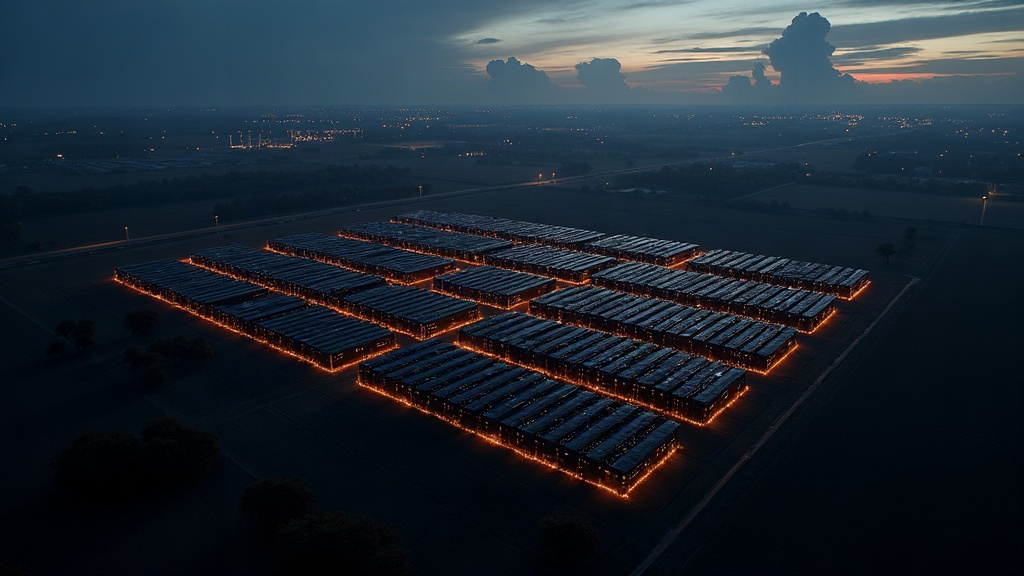
Amazon Web Services is evaluating roughly 1,000 acres in Sprigg Township, Adams County, Ohio for a campus that would reach 1,300 megawatts by 2032, according to reporting from Inside the Data Center, with additional coverage from Inside Climate News and the Cincinnati Enquirer. The proposed project, named the Buck Canyon campus, would be one of the largest data-center builds yet announced in the state.
What was filed
An Army Corps of Engineers site-work permit and an AES Ohio load filing mark the project's current stage. No final construction approval has been confirmed, and no building count or campus square footage appears in available reporting.
| Detail | Filed figure |
|---|---|
| Site area under evaluation | ~1,000 acres |
| Initial load target | 100MW (planned 2028) |
| Full campus capacity | up to 1,300MW (target 2032) |
| Grid interconnection | AES Ohio load filing |
Who AWS is
Amazon Web Services is the cloud-infrastructure arm of Amazon and one of the three largest hyperscale operators globally. AWS has been expanding its owned-and-operated data-center footprint across the United States, with major existing clusters in Virginia, Oregon, and Ohio's established Columbus corridor. The Buck Canyon filing, if it advances to construction, would represent a significant southward push within Ohio, well outside the Columbus metro where AWS already operates capacity.
Why Sprigg Township, and why now
- •Acreage at scale is increasingly scarce near primary markets. The Columbus metro, Ohio's current hyperscale center of gravity, faces tightening land availability and grid queues. A 1,000-acre rural site offers the contiguous footprint a 1,300MW campus requires.
- •AES Ohio transmission access. A direct load filing with AES Ohio suggests existing or expandable high-voltage infrastructure in the corridor, a prerequisite for any project at this power scale.
- •A zoning vote created a framework. On November 3, 2026, Sprigg Township voters approved township zoning 330 to 297, a 53%-47% margin, giving the township formal land-use authority over unincorporated areas for the first time. That outcome provides a regulatory structure within which a project of this size can be evaluated and permitted, rather than proceeding in a zoning vacuum.
Where a township establishes zoning at the same moment a hyperscale operator files grid-interconnection paperwork, the two moves together signal a project moving from site selection toward active permitting.
The infrastructure gap that defines this project
A 1,300MW campus phased over roughly four years, with an initial 100MW energization targeted for 2028, is as much a utility-coordination challenge as a construction one. AES Ohio will need to plan transmission upgrades on a timeline that matches AWS's load ramp, and the Army Corps site-work permit points to meaningful earthwork, drainage, or waterway considerations on the 1,000-acre parcel. Projects at this scale in rural counties often hit their hardest constraints not at the point of local approval but at the interconnection queue and the transformer supply chain. The 2028 initial-load date gives some indication of how AWS is sequencing those dependencies.
Local reception
The November 2026 zoning vote is the clearest measure of community sentiment available. A 53%-47% result is narrow. Voters who supported township zoning may have done so to ensure local oversight of exactly this kind of large industrial development, while the 47% opposed may reflect concern about adding regulatory friction to economic projects. Neither outcome represents a decisive mandate for or against the campus itself, and the Inside Climate News coverage situating this project within Ohio's broader data-center moratorium debate suggests the regulatory and political environment around large campus builds in the state remains unsettled.
What it means for the region's labor market
Adams County is rural, and Sprigg Township's small residential population cannot supply the trades depth a 1,300MW campus build demands. Construction labor will draw primarily from the Cincinnati metro roughly 60 miles northwest, the Portsmouth area, and northern Kentucky building trades. Electricians, millwrights, pipefitters, and commissioning specialists will almost certainly need to be imported in rotating crews rather than recruited locally, making lodging availability, drive-time logistics, and contractor retention as consequential as raw headcount. Competing industrial employers across southern Ohio, including manufacturing and energy operations, will put pressure on the same skilled-trades pipeline. Operations staffing for a campus this size is a years-long, multi-wave effort that typically begins well before first energization. For a full breakdown of roles, pay bands, and where the talent is coming from, see our guide to hiring data center talent in Adams County, Ohio.
Sources: Inside the Data Center, which first reported the Buck Canyon filing, with additional coverage from Inside Climate News and the Cincinnati Enquirer.
Have a data center role to fill?
Send us the role Monday. Get three screened candidates by Friday, ready to meet your hiring team.
Read More Blog Posts
Hiring Data Center Talent in Adams County, Ohio: Roles, Pay, and Where the People Actually Are
Amazon Web Services is evaluating roughly 1,000 acres in Sprigg Township, Adams County, Ohio for a campus that could reach 1,300 megawatts by 2032.
Hiring Data Center Talent in Holt, MI: Roles, Pay, and Where the People Actually Are
Ingham County is looking at one of the largest proposed data center campuses in the Midwest.