
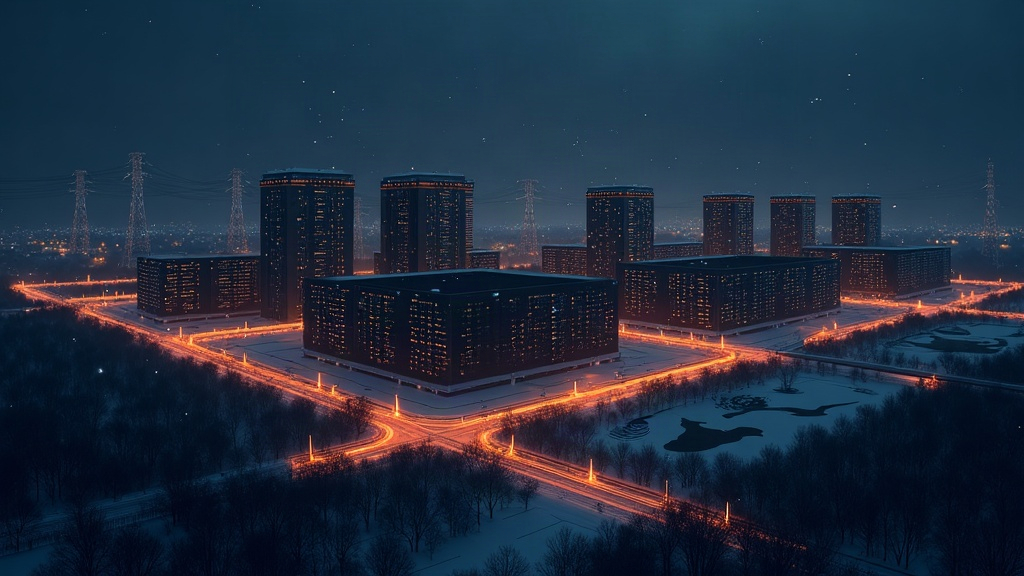
CleanCore Solutions, Inc. announced on July 29, 2026 that it had signed a 10-year colocation services agreement with Cerebras Systems for a data center campus in Minnesota, a deal carrying approximately $800 million in contracted value over its initial term. The same filing disclosed that on July 23, 2026 the company had entered into definitive agreements to develop the campus through a joint venture. First reported by PRNewswire, the announcement was subsequently covered by MarketWatch and detailed further in SEC filings via StockTitan.
What was filed
CleanCore disclosed a Tier 3 campus designed to deliver approximately 55 MW of utility power capacity and 40 MW of critical IT load at full buildout. Roughly 20 MW of utility power is already energized and supporting an initial 15 MW of critical IT load, with the remaining capacity expected online in Q1 2027, when revenue under the colocation agreement is scheduled to begin.
| Detail | Disclosed figure |
|---|---|
| Tier standard | Tier 3 |
| Total utility power capacity | ~55 MW |
| Critical IT load at full buildout | ~40 MW |
| Utility power currently energized | ~20 MW |
| Initial critical IT load online | ~15 MW |
| Remaining capacity expected | Q1 2027 |
| Colocation term | 10 years |
| Contracted value | ~$800 million |
| Initial approved budget | $479 million |
| Aggregate committed capital | up to $500 million |
| Initial JV contribution | $40 million ($25M at closing, up to $15M shortly after) |
| CleanCore JV ownership | 79% |
| Partner JV ownership | 21% |
The exact city, county, acreage, square footage, and building count were not disclosed in the sources reviewed and are omitted here.
Who CleanCore Solutions is
CleanCore Solutions, Inc. (NYSE American: ZONE) is positioning itself as a developer and operator of AI-oriented data center infrastructure. The Cerebras Systems agreement, a publicly traded AI chip and systems company (Nasdaq: CBRS), is CleanCore's marquee announced customer and reflects the company's strategy of anchoring large campuses to long-term AI workload commitments before construction completes.
Why Minnesota, and why now
The specific site has not been publicly identified, but the state-level rationale aligns with trends visible across the broader market.
- •Power availability at scale. Minnesota's grid infrastructure and relatively moderate climate reduce both energization timelines and cooling costs compared with warmer or more constrained markets.
- •AI demand is outrunning primary markets. Hyperscale and AI-inference operators are increasingly looking beyond Northern Virginia, Phoenix, and Dallas for sites where power, land, and permitting can move together at the pace AI build cycles require.
- •Anchor-tenant economics. A 10-year, $800 million agreement with a single AI customer provides the contracted revenue certainty that makes project-level financing at a $479 million initial budget viable for a developer of CleanCore's current scale.
When an AI operator commits to a 10-year anchor lease before a campus is fully built, it shifts the developer's primary constraint from demand to execution speed on power and commissioning.
The JV structure and what it signals
The 79/21 joint venture, with $40 million in initial contributions and up to $500 million in aggregate committed capital, is a financing structure designed to let CleanCore retain operational control while bringing in a capital partner to share the build risk. The staged contribution, $25 million at closing and up to $15 million shortly after, suggests milestones tied to construction progress rather than a single lump-sum draw. That structure keeps pressure on the development timeline and, by extension, on the labor pipeline needed to hit Q1 2027 energization of the remaining capacity.
What it means for the region's labor market
A 55 MW Tier 3 campus with a hard Q1 2027 deadline for the second phase is a compressed hiring event regardless of which Minnesota market it sits in. The state has a strong union and building-trades presence, and the Minneapolis-Saint Paul metro concentrates the commercial construction, utility, and mission-critical contractors most relevant to a project of this size. Electricians, mechanical and HVAC crews, controls technicians, and heavy-construction labor will all be in demand simultaneously, competing with other active industrial and logistics projects across the state.
The most consequential staffing reality here is the undisclosed site. Because the campus location has not been made public, the developer's early advantage belongs to any contractor or staffing partner that can pre-book scarce electrical and commissioning crews before competitors know where to bid. By the time the address is public, the best low-voltage and power-systems teams in Minnesota will already be spoken for on other projects. Acting now, on a state-level basis, is the move. For a full breakdown of roles, pay bands, and where the specialized talent sits across Minnesota, see our guide to hiring data center talent in Minnesota. Sources: PRNewswire, which first reported the announcement, with additional coverage from MarketWatch and SEC filings reviewed via StockTitan.
Have a data center role to fill?
Send us the role Monday. Get three screened candidates by Friday, ready to meet your hiring team.
Read More Blog Posts
Hiring Data Center Talent for CleanCore Solutions' Minnesota Campus: Roles, Pay, and Where the People Actually Are
Minnesota is about to have a data center staffing race, and the site has not even been publicly located yet.
Hiring Data Center Talent Near Yerington, Nevada: Roles, Pay, and Where the People Actually Are
Lyon County just approved a 1,000-megawatt data center campus in the middle of Mason Valley farm country, and the talent it needs does not live anywhere nearby.