
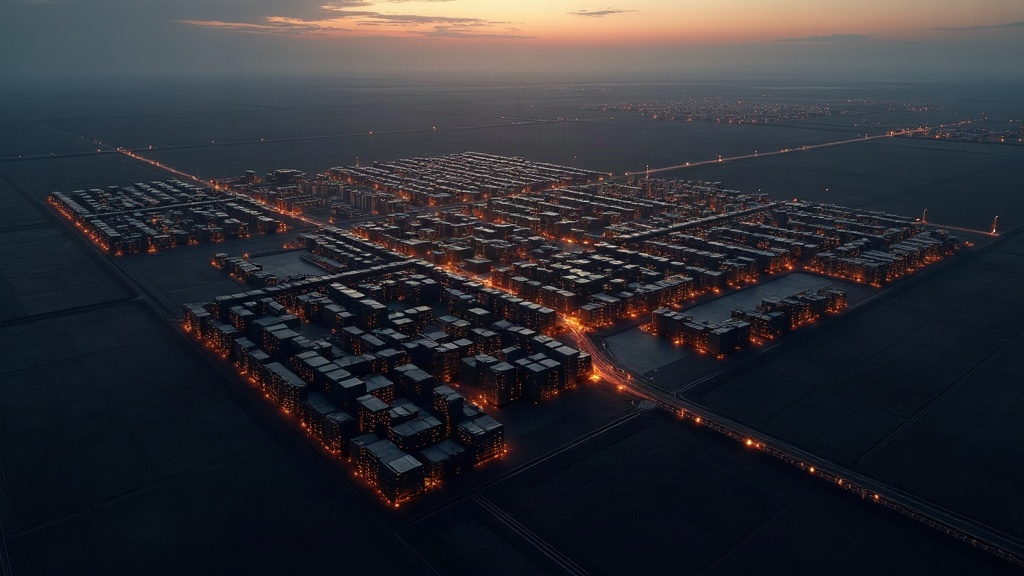
InfraTech Capital has announced a proposed $2.7 billion investment to develop a hyperscale-class data center campus on more than 5,000 acres in Carson County, Texas, near Amarillo. The project, first reported via InfraTech Capital's Business Wire press release on August 18, 2026 and subsequently covered by Data Center Dynamics and Yahoo Finance, is structured alongside a consortium of institutional co-investors and is expected to land a major hyperscaler as the anchor tenant, though both the tenant identity and co-investors remain undisclosed pending completion of due diligence.
What was filed
InfraTech Capital is characterizing its current position as "advancing a proposed investment" rather than announcing a fully approved project. No formal local permitting milestones or utility filings have been publicly cited. Specific figures for megawatt capacity, building count, and square footage will be disclosed after definitive agreements are finalized.
| Detail | Status |
|---|---|
| Total investment | approximately $2.7 billion |
| Site area | more than 5,000 acres |
| Location | Carson County, Texas, near Amarillo |
| Anchor tenant | major hyperscaler, undisclosed |
| Co-investors | institutional consortium, undisclosed |
| MW capacity | to be determined post-closing |
| Building count | not yet specified |
| Construction timeline | to be determined post-closing |
Alongside the campus itself, InfraTech Capital plans to invest in expanded fiber optic cable manufacturing capacity, adding new production lines with an unnamed global manufacturing partner to support the project's fiber needs and other large-scale digital infrastructure.
Who InfraTech Capital is
InfraTech Capital is a capital formation and development firm focused on large-scale digital infrastructure. The Carson County campus represents its most publicly visible project to date. Beyond the Texas Panhandle announcement, the company has not been identified in reliable public sources with a prior operating portfolio, so staffing firms should treat this as an emerging developer backed by institutional capital rather than an established multi-campus operator.
Why Carson County, and why now
- •Land availability at scale. A 5,000-plus-acre footprint is extraordinarily difficult to assemble near established metros. The Texas Panhandle's rural land market made it possible.
- •Texas grid and energy mix. ERCOT's deregulated structure and the Panhandle's abundant wind generation give developers flexibility on power sourcing that regulated-utility states cannot match.
- •Primary markets are tightening. Northern Virginia, Dallas-Fort Worth, and Phoenix are all facing power constraints and interconnection queues that push cost-sensitive hyperscale builds toward secondary and tertiary markets.
- •Carson County is becoming a corridor. InfraTech would join Fermi America's "Project Matador" in the same county, signaling that the area has cleared enough site, power, and fiber feasibility hurdles to attract multiple independent commitments.
When two independent hyperscale-class projects land in the same rural county within a short window, the location has cleared a credibility threshold that typically accelerates additional investment and infrastructure upgrades from utilities and fiber carriers.
Infrastructure insight: fiber manufacturing changes the labor equation
Most hyperscale campuses in rural markets generate a single, predictable demand curve: heavy civil and structural trades dominate early phases, high-voltage electrical work peaks at energization, and a smaller permanent operations crew carries the asset forward. The InfraTech campus breaks that pattern.
The addition of on-site fiber optic cable manufacturing capacity means this project will simultaneously recruit traditional industrial construction trades and specialized manufacturing technicians for production line buildout and ongoing operations. Those two talent pools overlap only partially. Industrial electricians with both data center and manufacturing line experience are scarce in any market; in a rural corridor that is also absorbing a parallel hyperscale build next door, that overlap group will be competed for aggressively and will price accordingly. Staffing firms that get ahead of this blended demand profile before definitive agreements close will be better positioned than those waiting for formal job postings.
What it means for the region's labor market
Carson County's labor market leans heavily on the Amarillo metro, roughly 20 to 30 miles from most Carson County sites and home to more than 200,000 people with deep roots in energy, agriculture, food processing, rail, and manufacturing. That industrial base produces electricians, ironworkers, and heavy-equipment operators whose experience on wind farms, power plants, and large processing facilities translates directly to hyperscale construction. The challenge is that Fermi America's Project Matador will be drawing from the same pool at roughly the same time, compressing the window before craft labor supply tightens and per-diem travel rates rise as contractors import workers from Lubbock, Oklahoma City, and Denver.
Permanent operations roles and fiber manufacturing technician positions will compete in a separate but equally thin local pipeline. Neither role category exists in meaningful numbers in a region historically defined by agriculture and energy extraction. For a full breakdown of roles, pay benchmarks, and where the talent is, see our guide to hiring data center talent in Carson County, Texas. Sources: the Business Wire press release dated August 18, 2026, which first reported the proposed investment, with additional coverage from Yahoo Finance and Data Center Dynamics.
Have a data center role to fill?
Send us the role Monday. Get three screened candidates by Friday, ready to meet your hiring team.
Read More Blog Posts
Hiring Data Center Talent Near Amarillo: Roles, Pay, and Where the People Actually Are in Carson County, TX
Carson County is about to have a data center hiring problem. InfraTech Capital announced a proposed $2.7 billion investment to develop a hyperscale-class campus spanning more than 5,000 acres in the Texas Panhandle, with
Hiring Data Center Talent in Vineland, NJ: Roles, Pay, and Where the People Actually Are
Vineland, New Jersey is about to have a data center hiring problem. DataOne Vineland is developing a 300-350 MW hyperscale AI campus on 106 acres off South Lincoln Avenue as a build-to-suit facility for Nebius Group, wit