
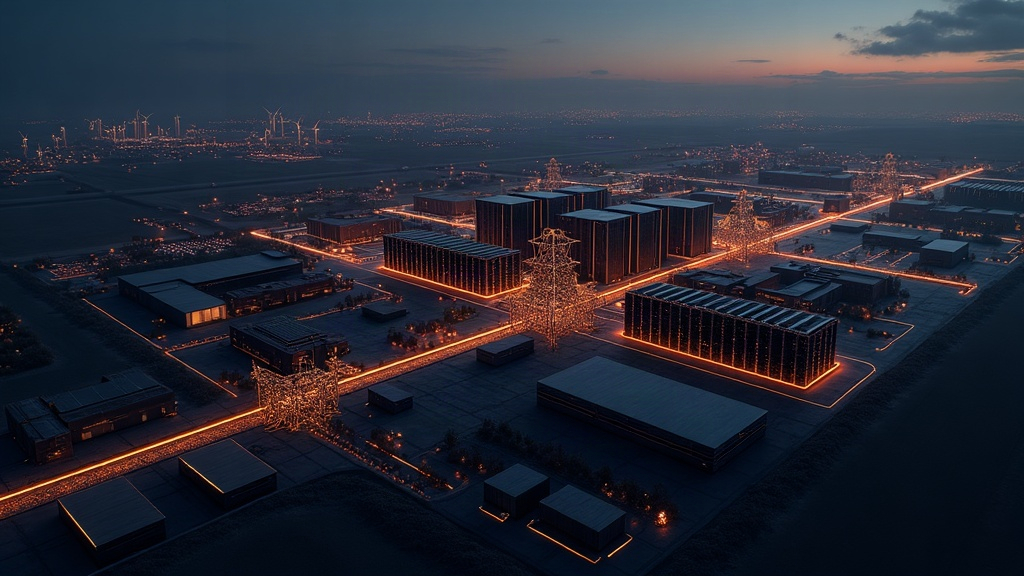
QTS Data Centers and Lancium have announced a joint plan to develop a hyperscale AI-ready campus at Lancium's Clean Campus in Hall County, near Turkey, Texas, with a total planned investment of more than $10 billion. The project was first reported by ABC7 Amarillo (KVII) and has been covered by Data Center Dynamics, Data Center Knowledge, and the AI for CRE Collective.
What was announced
Lancium owns the campus and is responsible for electrical and civil infrastructure. QTS will design, build, and operate the data center buildings. Both companies are funding the energy infrastructure improvements jointly.
| Detail | Announced figure |
|---|---|
| Total planned investment | more than $10 billion |
| Data center buildings | up to 11 |
| Site area | approximately 465 acres |
| Grid connection | 1 GW |
| On-site energy | solar generation and battery energy storage |
| Water use per building | roughly 50,000 gallons per month (closed-loop) |
The closed-loop cooling systems are designed to operate without drawing on Turkey's municipal water supply, a point that has already surfaced in local community discussions.
Who Lancium and QTS are
Lancium is a power-infrastructure-first developer that builds large Clean Campuses anchored by grid-scale energy assets, with existing campuses in Abilene and Childress, Texas. Its model is to own and operate the land, power, and civil backbone while hosting compute tenants and partners on top of that infrastructure. QTS Data Centers is a hyperscale colocation and build-to-suit operator with an existing Texas footprint around Fort Worth, Irving, and San Antonio. It brings the data center design, construction, and operations capability that sits on top of Lancium's power platform.
Why Hall County, and why now
- •The grid connection was the asset. A 1 GW grid tie in a rural Texas Panhandle county is not accidental. Lancium's campus model is built around securing transmission capacity in locations where land is cheap and power infrastructure can be developed at scale.
- •AI workloads demand dedicated gigawatt-scale power. Next-generation AI clusters require sustained, high-density power that shared urban campuses cannot easily provide. A purpose-built rural campus with on-site renewables and storage matches that requirement.
- •Texas's deregulated energy market supports the model. ERCOT's structure allows large industrial loads and co-located generation to be managed in ways that are difficult in regulated markets, making Lancium's integrated energy approach viable.
- •Primary markets face constraints. Northern Virginia, Dallas, and Phoenix are all experiencing power queue delays and land scarcity, pushing hyperscale demand toward alternative sites where greenfield development timelines are faster.
When a developer locks up a gigawatt of grid capacity in a low-cost rural county and pairs it with on-site renewables, the power asset itself becomes the reason the campus exists, and everything else follows.
Infrastructure at a scale that resembles a power plant
The single most important characteristic of this site is that it is not a conventional colocation build with a utility connection bolted on. A 1 GW grid tie combined with utility-scale solar and battery storage puts the electrical scope of this project closer to a large generation facility than to a typical data center campus. That distinction matters for every planning, procurement, and staffing decision made between now and commissioning. Substation construction, high-voltage transmission interconnection work, and utility-scale renewables installation will all run in parallel with the data center shell and MEP work, creating overlapping labor demands that are unusual even by hyperscale standards.
Local reception
Hall County residents have raised questions about water use, housing for construction workers, and broader economic impact, as reported by ABC7 Amarillo. The project team has addressed water concerns by pointing to the closed-loop cooling design and the absence of a connection to Turkey's municipal supply. On housing, coverage confirms that most construction workers are expected to be housed on-site during the development phase rather than drawing on local inventory in a small rural town. No formal zoning or planning opposition has been reported as of the time of this post, but community dialogue is active.
What it means for the region's labor market
Hall County has a minimal industrial base and no existing data center footprint. Local trades depth is limited, which means this project will source the bulk of its construction labor from regional markets, primarily Amarillo and Lubbock, each roughly 75 to 100 miles away. Both cities have active industrial and infrastructure pipelines that already compete for electricians, mechanical trades, and concrete crews, so lead times on skilled labor will be tighter than the rural location might suggest. Texas's low construction-unionization rate means staffing will flow through regional non-union contractors, including those already working on Lancium's Abilene and Childress campuses and QTS's existing Texas facilities. That existing contractor pipeline gives staffing firms a clear starting point for sourcing mission-critical talent that already understands Lancium's power-centric build model. The more distinctive labor requirement is the energy infrastructure itself. High-voltage transmission specialists, substation crews, and utility-scale solar and storage technicians will be needed in volume and in parallel with the data center trades, a combination that is closer to staffing a major renewable energy project than a standard colocation build. Firms that can bridge data center operations experience with power-plant-side electrical credentials will be best positioned to serve this campus across its full build-out. For a breakdown of roles, pay ranges, and where to find qualified candidates for this project, see our guide to hiring data center talent in Hall County, Texas. Sources: ABC7 Amarillo (KVII), which first reported community discussions around the project, with additional coverage from Data Center Dynamics, Data Center Knowledge, and the AI for CRE Collective.
Have a data center role to fill?
Send us the role Monday. Get three screened candidates by Friday, ready to meet your hiring team.
Read More Blog Posts
Hiring Data Center Talent in Hall County, TX: Roles, Pay, and Where the People Actually Are
Hall County is about to have a hiring problem unlike anything the Texas Panhandle has seen.
Hiring Data Center Talent in Spartanburg County, SC: Roles, Pay, and Where the People Actually Are
Spartanburg County is about to have a data center hiring problem. Valara Holdings, a subsidiary of NorthMark Strategies, is building a $2.8–$3 billion campus on South Pine Street, more than 900,000 square feet across fou