
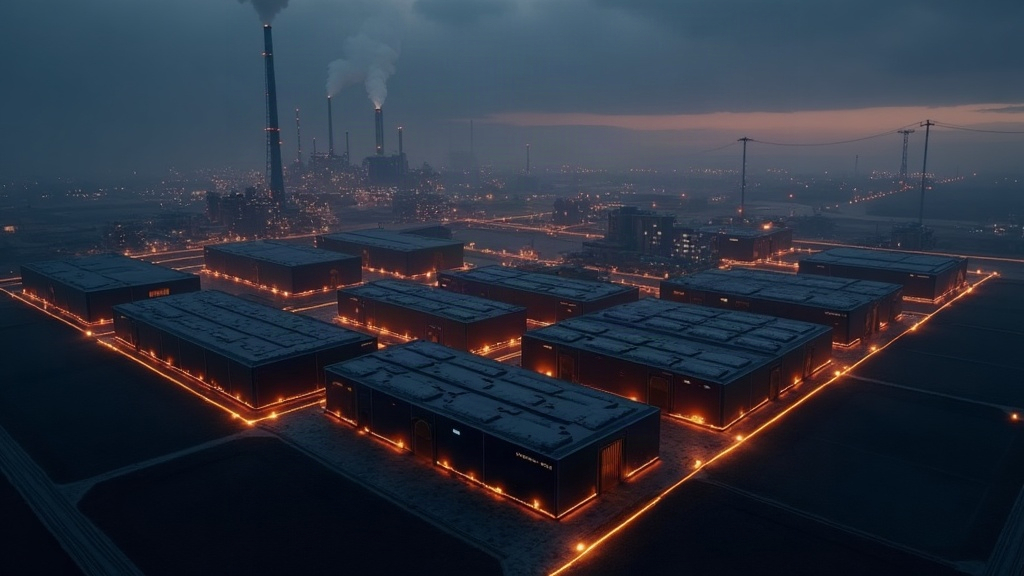
TeraWulf is building the Justified Data Campus on the roughly 790-acre former Century Aluminum smelter in Hawesville, Hancock County, Kentucky. The three-building campus will deliver approximately 401 megawatts of critical IT load, fully leased to AI company Anthropic under 20-year agreements, with a total development cost estimated at $4.0 billion to $4.5 billion. The project was first reported by TeraWulf in an SEC filing and covered by Fluor's newsroom and Reuters.
What was filed and approved
The definitive engineering, procurement, and construction agreement between TeraWulf and Fluor was signed on November 4, 2026, covering all three buildings. Fluor had received a limited notice to proceed in March 2026. The Kentucky Public Service Commission approved a 15-year electric-service agreement for up to 482MW on August 21, 2026, with power delivered through Big Rivers Electric Corp. and Kenergy Corp. using the transmission infrastructure already in place at the former aluminum facility.
| Detail | Figure |
|---|---|
| Site area | ~790 acres |
| Buildings | 3 (CB-1, CB-2, CB-3) |
| Critical IT load | ~401MW |
| Power approved | up to 482MW |
| Electric agreement term | 15 years |
| Lease term (Anthropic) | 20 years |
| Estimated development cost | $4.0B to $4.5B |
| Initial capacity online | second half of 2027 |
| Full phased delivery | through Q2 2028 |
Google separately agreed to provide credit support for financing tied to the Anthropic leases, adding a third major technology name to a deal that is already one of the largest single-tenant AI infrastructure commitments publicly disclosed.
Who TeraWulf is
TeraWulf is a digital infrastructure company that built its early profile in bitcoin mining before pivoting toward high-density AI and HPC colocation. The Justified Data Campus represents the company's largest and most consequential construction undertaking to date, moving it squarely into the hyperscale AI-leasing market with Anthropic as an anchor tenant and Fluor as its construction partner.
Why Hawesville, and why now
- •The power infrastructure was already built. The former Century Aluminum smelter required enormous, reliable electrical capacity. That transmission infrastructure, served by Big Rivers Electric and Kenergy, is already in place and rated for industrial-scale loads, which compresses the interconnection timeline significantly compared with a greenfield site.
- •AI compute demand is outpacing primary markets. Northern Virginia, Phoenix, and Silicon Valley are facing land, power, and water constraints. Developers are actively scouting secondary and tertiary markets that can offer large contiguous acreage and existing grid capacity.
- •A 20-year, fully committed lease de-risks construction financing. Anthropic's long-term commitment, backed by Google's credit support, gave TeraWulf and Fluor a bankable foundation to sign a full EPC agreement rather than proceed speculatively.
- •The brownfield site solves the acreage problem. Finding 790 contiguous, industrial-zoned acres with existing roads, utilities, and stormwater infrastructure near a transmission node is nearly impossible in core markets.
When a heavy industrial site closes, it leaves behind transmission capacity, cleared acreage, and an experienced local workforce that data center developers can inherit at a fraction of the cost of building those assets from scratch.
Infrastructure edge: inherited grid capacity
The aluminum industry is one of the most power-intensive manufacturing sectors in the world. The Century Hawesville smelter, which operated from 1969 until 2022, was designed around continuous, high-voltage industrial load. That means the substation infrastructure, the transmission interconnection points, and the physical corridors for electrical distribution already exist on-site. The Kentucky PSC's approval of up to 482MW of electric service reflects the realistic ceiling of that existing infrastructure, not a theoretical future build-out. For a data center operator, inheriting a site where the grid work is largely done is a material schedule and cost advantage.
What it means for the region's labor market
A $4.0 to $4.5 billion, three-building campus built in roughly 18 months of phased delivery is an extraordinary construction employment event for Hancock County and the broader Ohio Valley. The regional building-trades base is accustomed to heavy industrial work, which is exactly what this project demands during construction. The less obvious opportunity is in operations hiring after commissioning.
The former Century Aluminum workforce spent decades managing high-voltage switchgear, rotating equipment, industrial controls systems, and 24/7 continuous operations under strict reliability requirements. That experience maps directly to data center critical facilities roles: electrical technicians, mechanical technicians, controls and SCADA operators, and shift facilities managers. Hawesville is approximately 70 miles southwest of Louisville, so regional recruitment can draw on both the local industrial base and the Louisville metro's broader technical workforce. The project may also compete for trades labor with other major industrial and infrastructure work across the Louisville-Ohio Valley corridor, so early workforce planning will matter.
We break down the specific roles, pay bands, and where the talent pipeline sits in our guide to hiring data center talent in Hancock County, Kentucky. Sources: TeraWulf's SEC filing, which first disclosed the EPC agreement and project details, with additional coverage from Fluor's newsroom and Reuters.
Have a data center role to fill?
Send us the role Monday. Get three screened candidates by Friday, ready to meet your hiring team.
Read More Blog Posts
Hiring Data Center Talent in Hawesville, KY: Roles, Pay, and Where the People Actually Are
Hawesville, Kentucky is about to have a data center hiring problem. TeraWulf is developing the Justified Data Campus on the former Century Aluminum site, three buildings, 401 MW of critical IT load, and a 20-year lease w
Hiring Data Center Talent in Glen Rose, TX: Roles, Pay, and Where the People Actually Are
Amazon is building one of the most unusual data center campuses in the country. Project Spectrum, a planned 18-building, $5 billion campus on roughly 435 acres adjacent to Comanche Peak Nuclear Power Plant in Somervell C