
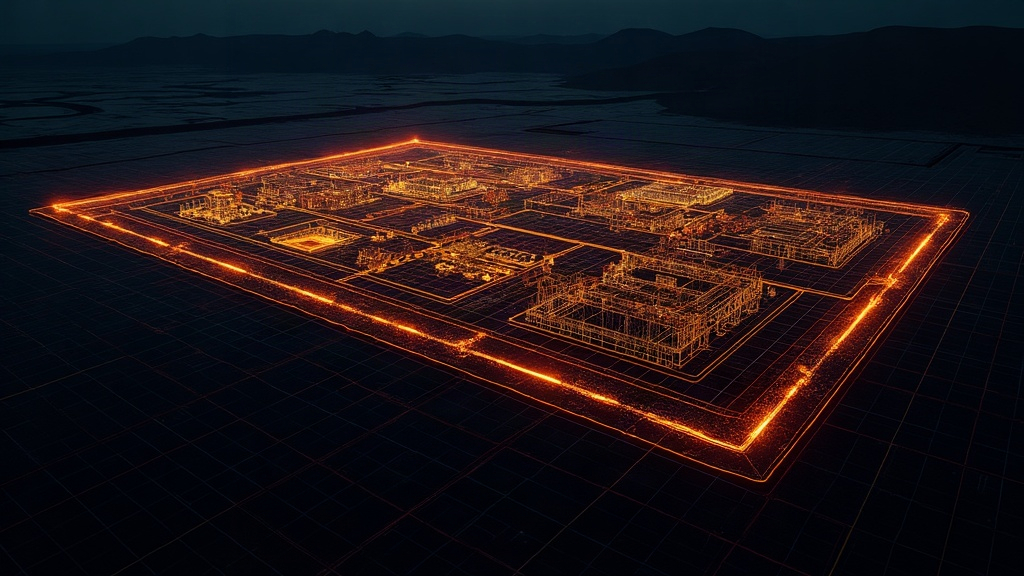
Townsite Solar 2, LLC received Bureau of Land Management approval on June 26, 2026 to build a hyperscale AI data center on approximately 80 to 88.5 acres of federally managed public land in Eldorado Valley, within the city limits of Boulder City, Clark County, Nevada. The approval was first reported by The Nevada Independent and has since been covered by KTNV Las Vegas, Field and Stream, and JDSupra. As of September 1, 2026, construction is paused under a federal stay while environmental appeals are adjudicated.
What was approved, and what is now paused
BLM approved the project by amending a prior right-of-way grant that had authorized a 19MW solar generating facility and a 35MW battery energy storage system on the same parcel. Rather than build the solar plant, Townsite Solar 2 will, if the stay is lifted, build a data center instead. No building count, square footage, or total capital investment figure has been publicly reported.
| Detail | Reported figure |
|---|---|
| Site area | 80 to 88.5 acres of BLM land |
| Distance from Boulder City | approximately 5 miles southwest |
| Distance from Lake Mead NRA | approximately 10 miles |
| Power demand | up to 167MW |
| Construction-phase water demand | approximately 400,000 to 600,000 gallons per year |
| BLM approval date | June 26, 2026 |
| Stay issued | September 1, 2026 |
At 167MW, this single facility would draw more electricity than Boulder City currently consumes as a municipality, making power and water impact the central regulatory flashpoints.
Who Townsite Solar 2 is
Townsite Solar 2, LLC is the named developer and proposed operator of the facility. No named anchor tenant or third-party colocation customer has been disclosed in any cited source. The developer's prior authorization on this parcel was for solar and battery storage, which means the right-of-way amendment represents a fundamental pivot in land use rather than an incremental expansion.
Why Boulder City, and why now
- •The transmission infrastructure was already permitted. The existing right-of-way grant for solar and battery storage meant BLM had already evaluated the parcel, giving Townsite Solar 2 a faster regulatory path than a greenfield application on undisturbed land.
- •Primary Nevada markets face constraints. Northern Nevada's data center corridor around Reno has absorbed significant hyperscale investment; southern Nevada offers proximity to the Las Vegas metro's deep construction trades labor pool and existing high-voltage transmission assets.
- •Federal land is the new frontier for AI buildout. With private industrial land scarce near adequate power in the West, developers are increasingly looking at BLM-managed parcels in energy corridors as the only available canvas for 100MW-plus campuses, a trend analyzed in depth by JDSupra.
The federal legal challenge and its practical effect on the project
On September 1, 2026, the Interior Department's Board of Land Appeals and an Interior Department judge jointly issued a stay halting construction and pausing BLM's approval. The appeals allege violations of the National Environmental Policy Act and inadequate project-specific environmental review. No final determination has been issued, and the project cannot break ground until the appeals are resolved. The non-obvious risk here is structural, not temporary. Because the site sits on federal public land under BLM jurisdiction rather than a city-owned industrial parcel, every phase of this project is subject to federal administrative law timelines, appellate review, and the political pressures that attach to public-lands controversies. Contractors and trade workers weighing this job against competing large projects in the Las Vegas valley should model a range of preconstruction scenarios, including extended delays of uncertain duration.
What it means for the region's labor market
A 167MW campus on a 5-mile-from-town BLM site is a meaningful hiring event for Clark County trades the moment the stay is lifted. Boulder City's workforce history runs through Hoover Dam operations, high-voltage transmission, and civil construction, and the broader Las Vegas metro supplies a deep bench of unionized and non-union electricians, linemen, heavy equipment operators, and specialized mechanical trades already active on resort, gaming, and energy projects across the valley. The challenge is timeline uncertainty. Workers and contractors who would otherwise be competitive for civil, electrical, and commissioning work here must weigh this project against more predictable large builds elsewhere in the valley. When the project does move to operations, compensation benchmarks from current Nevada market data give useful anchors for workforce planning:
| Role | Approximate annual comp |
|---|---|
| Commissioning engineer | approximately $147,000 |
| Critical-facilities engineer | $117,000 to $147,000 |
| Critical-facilities technician | approximately $89,000 |
| Facilities technician | approximately $54,000 |
Existing data center density in the immediate Boulder City and Eldorado Valley area is minimal, meaning most operations talent will commute from or relocate from the Las Vegas metro. Staffing firms sourcing for this project when it does move forward will be competing against every other large tech and resort expansion in Clark County for the same electricians and critical-environment technicians. For a full breakdown of roles, pay bands, and where the talent is concentrated, see our guide to hiring data center talent in Clark County, Nevada. Sources: The Nevada Independent, which first reported the federal stay, with additional coverage from KTNV Las Vegas, Field and Stream, and JDSupra.
Have a data center role to fill?
Send us the role Monday. Get three screened candidates by Friday, ready to meet your hiring team.
Read More Blog Posts
Hiring Data Center Talent in Boulder City, NV: Roles, Pay, and Where the People Actually Are
Boulder City is about to have a data center hiring problem, assuming its legal situation resolves.
Hiring Data Center Talent in Prosper, TX: Roles, Pay, and Where the People Actually Are
Project Tomahawk has a hiring problem that starts before a single shovel breaks ground.