
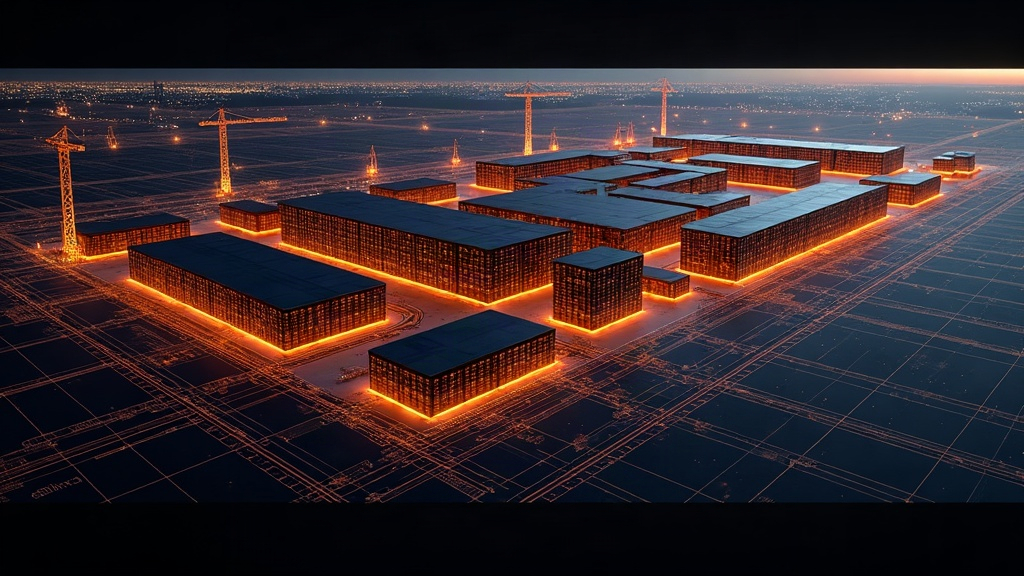
Valara Holdings, LLC, a subsidiary of NorthMark Strategies, is actively building a private data center campus on South Pine Street in unincorporated Spartanburg County, South Carolina. The project, valued at $2.8–$3 billion, will span more than 900,000 square feet across four buildings and is paired with a dedicated natural-gas power plant in the 450–460 megawatt range. Construction is underway and is planned to continue through 2028, as first reported by The State and covered by WIS, WYFF4, and FOX Carolina.
What was filed and built
The campus sits on nearly 300 acres near 4000 Pine Street in a largely residential stretch of Spartanburg County. Permits and news releases describe four data center buildings, a power yard, internal roadways, a site access road, and electrical equipment houses. The onsite gas plant is built solely to serve the campus, not the public grid.
| Detail | Figure |
|---|---|
| Total investment | $2.8–$3 billion |
| Buildings | 4 |
| Total floor area | More than 900,000 sq ft |
| Onsite generation | 450–460 MW (natural gas, private use) |
| Site footprint | Nearly 300 acres |
| Construction timeline | Active through 2028 |
Who Valara Holdings is
Valara Holdings, LLC is a development subsidiary of NorthMark Strategies. The Spartanburg County campus appears to be among its most capital-intensive public-facing projects, structured around the private-generation model that lets the developer sidestep public utility procurement timelines entirely by building its own dedicated power supply.
Why Spartanburg County, and why now
- •Power on their own terms. By pairing the campus with a captive 450–460 MW gas plant, Valara avoids dependence on utility interconnection queues that are clogging project timelines across the Southeast.
- •I-85 corridor access. Spartanburg sits along one of the South's busiest industrial corridors, with strong logistics infrastructure and proximity to the Greenville-Spartanburg metro labor market.
- •Upstate land availability. Unlike Charlotte or Atlanta, Spartanburg County offered the near-300-acre contiguous footprint that a four-building hyperscale campus requires.
- •Limited prior hyperscale presence. The county has not been a primary data center market, which means less competition for entitlements, fewer NIMBY precedents in the industrial base, and less entrenched zoning resistance from data center neighbors.
Developers willing to build and own private generation capacity can move faster than those waiting on utility interconnection, but they inherit the full operational complexity of running a 450-plus megawatt power facility.
Regulatory picture as of August 2026
The project has drawn meaningful opposition. The Southern Environmental Law Center and local residents filed lawsuits and motions for preliminary injunction, arguing the project falls under South Carolina's Utility Facility Siting and Environmental Protection Act and requires Public Service Commission approval before the gas plant can operate. On August 27, 2026, the PSC dismissed that challenge, ruling that Valara, generating power solely for its own facility as a private business, is not subject to the state utility-siting rules in question and does not need PSC approval.
Separate local legal actions, including a motion for a temporary injunction and a county-level proposal for a one-year moratorium on new data centers, remain active. County officials have explicitly stated that the Valara project, already under construction, is not subject to the proposed moratorium. Construction has continued through the litigation.
What it means for the region's labor market
Spartanburg County brings real trades depth. BMW's manufacturing plant in nearby Greer and decades of automotive and advanced manufacturing supply-chain growth have built a regional workforce with strong mechanical, electrical, civil, and industrial maintenance skills. Most large-project contractors draw from the broader Greenville-Spartanburg corridor on a non-union basis, and that pool is capable of supporting a four-building construction program.
The complication is the gas plant. A captive 450-plus megawatt generation facility is not a typical data center mechanical yard. It requires high-pressure gas system specialists, combustion turbine operators, and power-plant-grade instrumentation and controls technicians. That experience in Spartanburg County is concentrated inside regional utility operations, not private-sector contractor pipelines. Valara and its contractors will almost certainly need to recruit outside the immediate market, drawing from utility operations across the Carolinas or competing for talent with the I-85 corridor's ongoing wave of automotive and logistics expansions that are already absorbing skilled trades at volume.
For staffing firms, the near-term construction wave is addressable with regional sourcing. The operations and power-plant workforce is a harder, longer fill requiring a wider net from the start. We break down roles, pay benchmarks, and where the talent is in our guide to hiring data center talent in Spartanburg County. Sources: The State, which first reported the project, and trade and local coverage by WIS, WYFF4, and FOX Carolina.
Have a data center role to fill?
Send us the role Monday. Get three screened candidates by Friday, ready to meet your hiring team.
Read More Blog Posts
Hiring Data Center Talent in Spartanburg County, SC: Roles, Pay, and Where the People Actually Are
Spartanburg County is about to have a data center hiring problem. Valara Holdings, a subsidiary of NorthMark Strategies, is building a $2.8–$3 billion campus on South Pine Street, more than 900,000 square feet across fou
Hiring Data Center Talent in Carbon County, PA: Roles, Pay, and Where the People Actually Are
Carbon County is about to have a data center hiring problem. Keel Infrastructure's Carbon Node East campus near Nesquehoning is planned at 1.2 million square feet across four Tier III buildings, with 350 MW of secured ut