
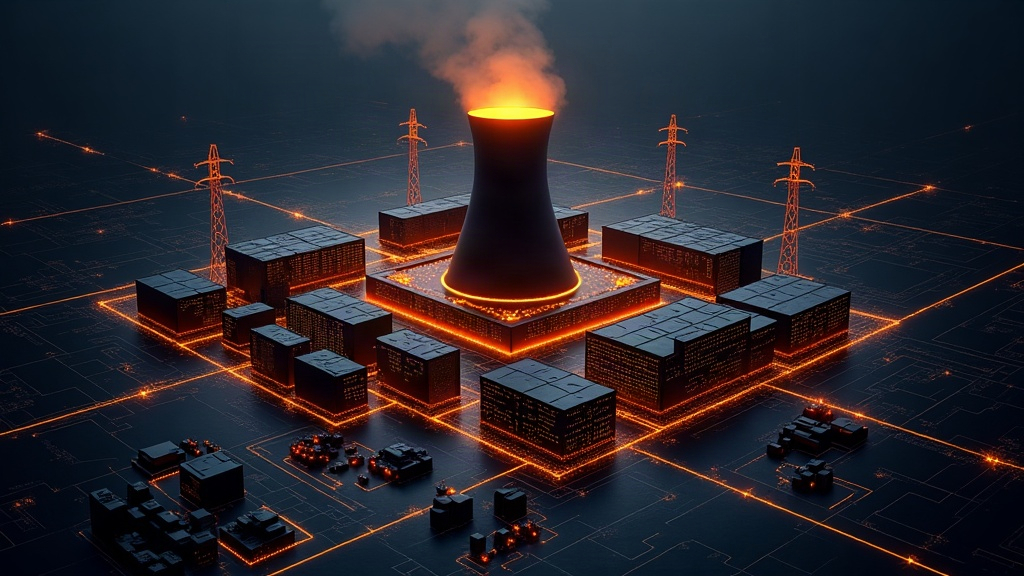
Island Roadhouse Data Centers has disclosed a nuclear-powered AI campus planned for Missouri, with phase one designed to deliver up to 154 megawatts of sellable IT load. Commercial operations are targeted for 2034. The site has no formal county approval yet, which means the hiring timeline feels distant until it does not. The roles this campus needs, particularly for commissioning a behind-the-meter supercritical CO2 power system and closed-loop liquid cooling infrastructure, are among the most specialized in the industry. Sourcing them takes years, not quarters.
Data center hiring comes in three waves
- •Construction and trades, first. Civil, structural, and MEP contractors mobilize early. For a campus of this technical complexity, trades with nuclear-adjacent and heavy industrial backgrounds will be in demand alongside standard data center subcontractors.
- •Commissioning, the pressure point. This is the bottleneck every developer underestimates. Commissioning engineers for a novel power configuration, including advanced reactors and a supercritical CO2 Brayton cycle, are a national search by definition. There are no deep benches here.
- •Operations, for the life of the building. Critical facilities engineers and technicians staff the building for decades. Some will be recruited nationally; others will be developed locally from industrial and utility backgrounds.
The construction wave is a local trades problem; commissioning and operations are national.
What these roles pay in 2026
| Role | Average base | Typical range |
|---|---|---|
| Commissioning engineer | ~$147,000 | $84,000 to $196,000 |
| Critical facilities engineer | Not specified | $117,000 to $147,000 |
| Critical facilities technician | ~$89,000 | Not separately published |
| Facilities technician (entry) | ~$54,000 | $42,500 to $77,000 |
St. Louis has a lower cost of living than coastal markets, but nuclear and AI infrastructure candidates with the right credentials command national rates regardless of location.
The certifications and background that actually matter
For commissioning roles on this campus, the credentials that matter most are not standard data center tickets. Candidates with Certified Commissioning Professional credentials, hands-on experience with combined heat and power or waste-heat recovery systems, and any exposure to closed-loop liquid cooling will stand out. For operations, OSHA 30, NFPA 70E, and EPA 608 are baseline. A background in utility operations, industrial process control, or nuclear plant support functions translates directly to the demands of a behind-the-meter advanced reactor site. Hiring managers should prioritize demonstrated systems-level thinking over any single credential.
How to structure the offer
For commissioning engineers hired before the building is operational, expect to carry per diem and travel costs if the candidate must relocate or work across multiple project sites. Full relocation packages are standard for senior operations hires. Contract-to-permanent structures work well for commissioning roles, where the engagement is naturally time-bounded. Permanent offers from day one are more appropriate for critical facilities engineers and senior operations leads who will own the building long-term. Given the 2034 target for commercial operations, some early operations hires may bridge through commissioning work or vendor-side roles before transitioning to permanent staff.
Candidates with the right nuclear and AI infrastructure background know their value, and offers that trail coastal benchmarks will not close.
Where each role actually gets sourced
Commissioning engineers for novel power systems come almost entirely from direct outreach to people currently employed, typically at engineering firms, EPC contractors, or OEM commissioning teams. They do not apply to job boards. Critical facilities engineers are sourced through a mix of referrals, targeted outreach to candidates in existing St. Louis-area data centers operated by firms like TierPoint, Netrality, and H5, and national searches for candidates open to relocation. Entry-level technicians and trades can be recruited locally through IBEW, UA pipefitters, and apprenticeship programs tied to St. Louis's industrial construction sector. Low-voltage and DCIM-oriented roles often come through data center operations communities and industry forums.
The St. Louis reality: strong on industrial trades, thin on nuclear-and-data-center overlap
St. Louis's union building trades are genuinely deep. IBEW locals, pipefitters, and steamfitters here have built utility substations, heavy manufacturing facilities, and commercial data centers. That foundation matters for construction. The non-obvious problem is at the intersection of nuclear power operations and data center critical facilities. St. Louis does not have an operating commercial reactor in its immediate labor shed, so the people who understand behind-the-meter advanced reactor operations are not local. They are at reactor sites in the Midwest and Southeast, at national labs, and at engineering firms that support the nuclear industry. Recruiting them to St. Louis requires competing on compensation, mission, and quality of life, not on geographic convenience.
The second pressure point is timing. St. Louis County drafted detailed data center regulations before any large project was formally entitled, a sign that regulators here intend to move carefully. Projects that engage county officials and union leadership early will have an advantage when it comes to labor availability, because which projects clear the county's permitting screens first will shape which ones can lock in contractor commitments.
The timeline is the hiring plan
A 2034 commercial operations target gives Island Roadhouse more runway than most, but that runway closes faster than it appears. The commissioning team for a first-of-kind power configuration needs to be identified and in conversations no later than two to three years before operations begin. Key operations leadership, particularly the critical facilities director and lead engineers, should be in place during the late construction and commissioning phase so they can learn the building before it goes live. Working backward from 2034, senior operations hiring should begin in earnest around 2030 to 2031, with commissioning recruitment starting before that.
How NextDCX helps
NextDCX recruits for your toughest data center roles. Share the work, location, and experience your team needs. We run a fresh search for every role, approach people directly, and speak with every candidate before introducing them. You get people screened for the work, pay, location, and availability, ready to meet your hiring team. We also support recruiting partners. If the Island Roadhouse Missouri campus is on your board, send us the roles and we start now. For the buildout details, see Island Roadhouse's Missouri campus disclosure. Comp sources: ZipRecruiter and dcgeeks 2026 salary data.
Have a data center role to fill?
Send us the role Monday. Get three screened candidates by Friday, ready to meet your hiring team.
Read More Blog Posts
Northampton Capital Partners and Provident Data Centers Form Joint Venture for 54 MW North Dallas Data Center
Northampton Capital Partners LLC and Provident Data Centers, a division of Dallas-based Provident, announced a joint venture on September 3, 2026, to develop a 54 MW critical-capacity data center in the North Dallas Corr
Island Roadhouse Data Centers Discloses Nuclear-Powered AI Campus Targeting 154MW in Missouri by 2034
Island Roadhouse Data Centers has disclosed a design for an integrated AI data center campus it plans to build in Missouri, with phase one targeting up to 154 megawatts of sellable IT load and a commercial operations sta