
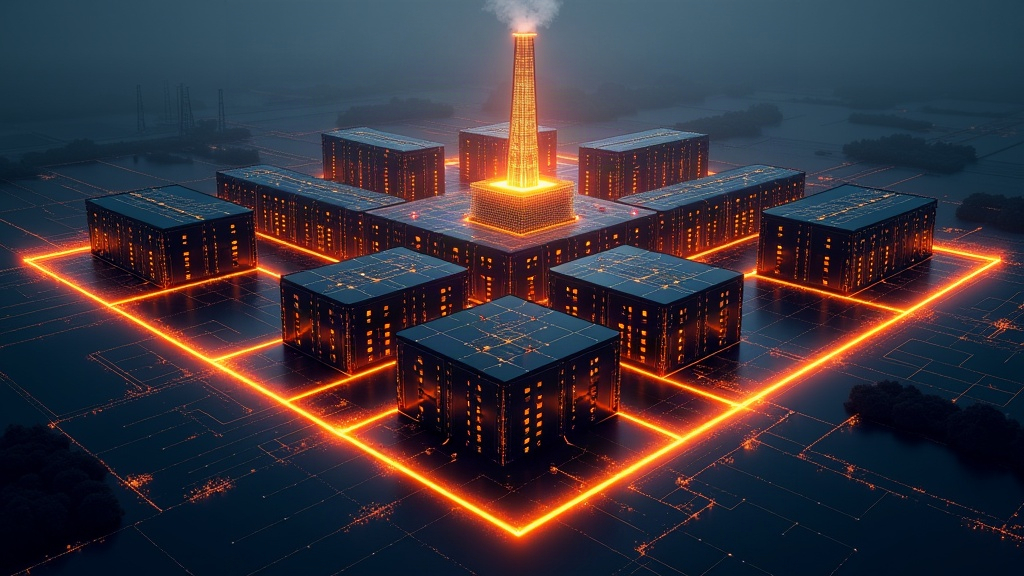
Island Roadhouse Data Centers has disclosed a design for an integrated AI data center campus it plans to build in Missouri, with phase one targeting up to 154 megawatts of sellable IT load and a commercial operations start date of 2034. The announcement was first reported by CINIE and picked up by the Daily AI Brief.
What was disclosed
The campus is designed to operate behind the meter, powered entirely by on-site advanced nuclear reactors in an N+1 configuration. Reactor heat is converted to electricity through an indirect closed supercritical CO2 Brayton cycle, a generation technology well outside the standard diesel-and-utility playbook most operators rely on today.
| Detail | Disclosed figure |
|---|---|
| Phase one IT load | Up to 154MW sellable |
| Target commercial operations | 2034 |
| Power source | On-site advanced nuclear reactors (N+1) |
| Cooling approach | Closed-loop warm-water liquid cooling with dry heat rejection |
| Grid relationship | Behind the meter |
The campus also includes a thermal network designed to supply waste heat to third-party industrial users, and the entire cooling system is described as low-water-use, which directly addresses one of the sharpest regulatory pressure points for large data centers in the Midwest.
Who Island Roadhouse Data Centers is
Island Roadhouse Data Centers is an emerging developer with a stated focus on AI infrastructure. The company's disclosed campus design is notable for combining three technologies that most established operators are still evaluating separately: small modular or advanced nuclear generation, supercritical CO2 power conversion, and industrial waste-heat monetization. No operating campuses are publicly identified at this stage. The Missouri project, if built on the disclosed timeline, would be among the first behind-the-meter nuclear-powered commercial data center campuses in the United States.
Why Missouri, and why now
- •Power procurement is the bottleneck for AI infrastructure nationwide. Grid queues in primary markets stretch years. A behind-the-meter nuclear design sidesteps utility interconnection entirely, which is increasingly a competitive advantage rather than a novelty.
- •Missouri offers a lower-cost industrial land base than coastal alternatives, with established heavy-trades labor and existing utility-scale infrastructure corridors near St. Louis.
- •The supercritical CO2 cycle produces heat that has economic value. Locating near industrial offtakers for waste heat improves project economics and creates a differentiated sustainability narrative for enterprise customers.
- •Regulators are already writing the rules. St. Louis County officials have publicly drafted data center siting regulations before any large project has been formally entitled, which signals that local government is preparing for this category of development rather than being surprised by it.
Behind-the-meter nuclear generation converts a long-lead power procurement problem into an on-site construction and licensing problem, which is one that experienced project developers are better positioned to control.
One infrastructure detail worth tracking
The supercritical CO2 Brayton cycle is not a standard data center power train. It requires specialized commissioning expertise distinct from what conventional gas turbine or diesel generator crews provide. The same is true of the nuclear reactor units themselves, which will require Nuclear Regulatory Commission licensing steps on a timeline that runs in parallel with, and potentially governs, the 2034 commercial operations target. Any operator or vendor evaluating this project as a future customer or partner should be tracking the NRC process, not just the construction schedule.
Local reception
As of mid-September 2026, no application or formal filing tied to Island Roadhouse Data Centers has appeared in St. Louis County's approval pipeline. Local officials have publicly stated there is no developer and no site for any large data center proposal in unincorporated St. Louis County, and county spokespeople have specifically addressed and denied rumors of a South County proposal near the Baumgartner Road and Ameren area, according to reporting by Call Newspapers and KSDK First Alert 4. The campus remains a disclosed design, not an entitled project, as of this writing.
What it means for the region's labor market
A 154MW nuclear-powered campus is a construction event unlike anything the St. Louis trades have built before. The region's unionized building trades have the depth for large, technically complex industrial builds, and the broader metro already supports data center operators including TierPoint, Netrality, and H5 Data Centers, which means experienced electricians, pipefitters, HVAC technicians, and low-voltage specialists are present in the labor shed. The complication is competition: a 120MW data center approved near the St. Louis Armory and multiple competing industrial redevelopments will bid against this project for the same contractors. St. Louis County has also drafted data center regulations before a single large project has been formally sited, per the St. Louis American, meaning that whichever developers engage county regulators and union leadership earliest are likely to have first call on available labor when permitting opens. For operators and developers tracking this campus, the hiring window begins well before shovels move. We break down roles, pay, and where the talent is in our guide to hiring data center talent in St. Louis County.
Sources: CINIE, which first reported the campus disclosure; Daily AI Brief; Call Newspapers; St. Louis American; KSDK First Alert 4.
Have a data center role to fill?
Send us the role Monday. Get three screened candidates by Friday, ready to meet your hiring team.
Read More Blog Posts
Hiring Data Center Talent in St. Louis for Island Roadhouse's Nuclear AI Campus
Island Roadhouse Data Centers has disclosed a nuclear-powered AI campus planned for Missouri, with phase one designed to deliver up to 154 megawatts of sellable IT load. Commercial operations are targeted for 2034.
Hiring Data Center Talent in Weld County, CO: Roles, Pay, and Where the People Actually Are
Weld County is about to have a data center hiring problem. Global AI (Colorado), LLC received a unanimous Use by Special Review permit on September 9, 2026, to convert a 400,000-square-foot former Kodak/Carestream manufa