
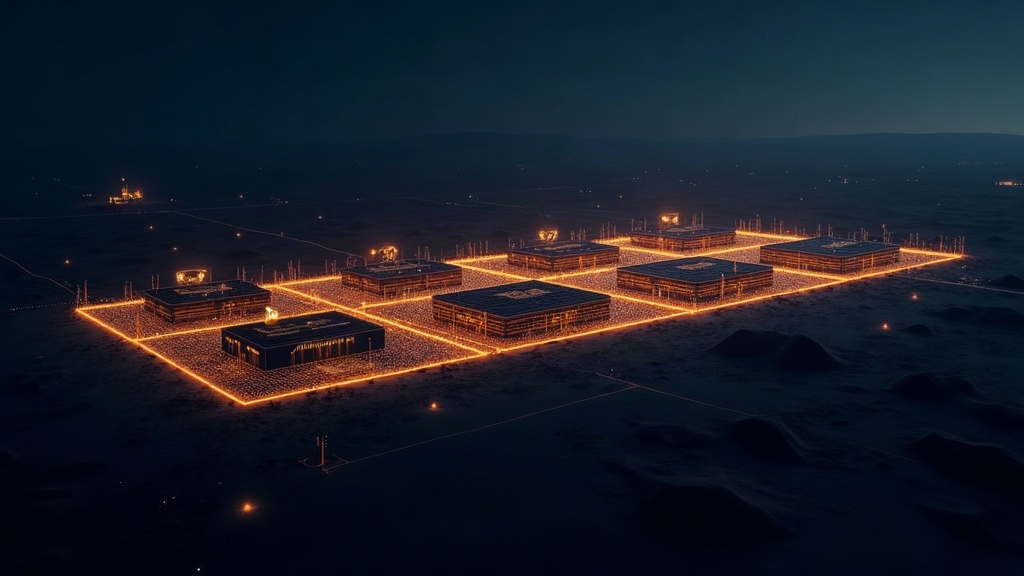
QTS Data Centers is planning the Caprock Campus in Midland, Texas, four buildings rated at approximately 300 megawatts each, totaling roughly 1.2 gigawatts of capacity, powered by on-site natural-gas generation and targeted for phased activation from late 2029 through September 2030. The talent this project needs is not sitting idle in the Permian Basin. Midland knows how to build big things and power them. What it has almost never had to do is staff a hyperscale data center operations team. That gap is where this hiring problem lives.
Data center hiring comes in three waves
- •Construction and trades, first. Civil, structural, electrical, and mechanical crews build the shell, the power plant, and the infrastructure. This wave peaks early and winds down before the building goes live.
- •Commissioning, the pressure point. Commissioning engineers and critical-facilities engineers validate every system before the keys turn. This work requires people who have done it before on hyperscale iron. There is no substitute for prior reps.
- •Operations, for the life of the building. Critical-facilities engineers, technicians, and shift leads run the site for decades. At 1.2 gigawatts across four buildings, the operations headcount will be substantial and the hiring timeline runs for years.
The construction wave is a local heavy-industry problem. Commissioning and operations are national searches.
What these roles pay in 2026
| Role | Average base | Typical range |
|---|---|---|
| Commissioning engineer | ~$147,000 | $84,000 to $196,000 |
| Critical-facilities engineer | ~$132,000 | $117,000 to $147,000 |
| Critical-facilities technician | ~$89,000 | varies by experience |
| Facilities technician (entry) | ~$54,000 | $42,500 to $77,000 |
Midland's cost of living is elevated by oilfield economics. Candidates relocating from major metros will find housing expensive relative to other secondary markets, and candidates already in the basin will benchmark compensation against oilfield wages. Plan your offers accordingly.
The certifications and background that actually matter
For commissioning engineers: prior hyperscale or colocation commissioning credits, documented experience with medium-voltage switchgear, generators, and chilled-water or direct-expansion cooling, and familiarity with integrated systems testing protocols. RCDD or BICSI credentials are secondary to hands-on commissioning history. For critical-facilities engineers and technicians: an electrical license or strong military electrical background (Navy nuclear, Army 25U, Air Force 3E0) is the most reliable pipeline. Experience with DCIM platforms, BMS, and generator controls matters more than any single certification. CDCP, CDCE, or equivalent Uptime Institute credentials signal the right career track. For the energy-side roles specific to this campus: natural-gas generation and standby power experience is a genuine differentiator given the on-site generation model. Workers coming out of gas-processing and power-generation roles in the Permian may hold relevant mechanical and electrical skills that translate faster than average.
How to structure the offer
Relocation. For commissioning and senior operations roles, a full relocation package is table stakes. Midland is not a city candidates relocate to without financial support. A lump-sum of $8,000 to $15,000 is standard for experienced hires; some employers go higher for lead engineers. Per diem. Commissioning engineers often prefer contract or per-diem structures tied to the commissioning window. Budgeting a daily rate plus housing allowance keeps competitive candidates engaged for a defined engagement without requiring a permanent commitment they may not want. Contract vs. permanent. Commissioning roles are routinely filled on a contract basis. Operations roles should be permanent. Mixing the two in the same offer creates confusion. Be explicit about which bucket a role sits in and what the path to permanent looks like if one exists.
Oilfield competitors in the Permian are offering retention bonuses and shift differentials that a standard data-center base offer will not beat on paper, so the total-compensation story including health benefits, predictable schedules, and career track matters in every conversation with a local candidate.
Where each role actually gets sourced
Construction and trades. Local Midland and Permian Basin contractors, regional union halls if trades organizations are active on this project, and the same workforce that staffs pipeline and gas-plant construction across West Texas. Commissioning engineers. National search. Active commissioning engineers are working on other hyperscale projects in Northern Virginia, Phoenix, Dallas, and Chicago. They are not posting resumes. They have to be approached directly with a specific opportunity. Critical-facilities engineers. National search with a secondary channel in military separation pipelines. Joint Base San Antonio produces a steady stream of separating enlisted personnel with the right electrical and mechanical backgrounds. Entry-level technicians. Community college electrical programs in the Midland-Odessa area, vocational training pipelines, and internal promotion from construction-phase crews who want to stay on-site.
The Midland reality: deep on energy workers, nearly empty on mission-critical operators
This is the non-obvious problem. Midland's labor market is genuinely strong for heavy construction and industrial work. Mining, logging, and construction accounted for 34.2 percent of local industry employment, and the Permian supplies experienced equipment operators, electricians, pipefitters, and instrumentation technicians who know how to work around high-voltage equipment in demanding outdoor conditions.
The same industrial culture that makes Midland's construction workforce capable creates a gap at the commissioning and operations layer, because almost nobody in this market has ever staffed a hyperscale data center, and the skills are related but not identical.
A Permian electrician understands power. A data center commissioning engineer understands power plus sequence of operations, integrated systems testing, and the specific failure modes of a mission-critical facility under load. That translation takes time and mentorship. For a 1.2-gigawatt campus activating in phases, QTS cannot wait for the local market to develop those skills organically. The commissioning and senior operations team will need to come from outside, with a plan to build local bench strength over the operations lifecycle.
The timeline is the hiring plan
Phased activation starts late 2029. That sounds distant. For commissioning engineers, it is not. Lead times on experienced commissioning talent run six to twelve months from first contact to start date, and the best people are being recruited for projects activating at the same time. Construction-phase electrical and mechanical crew recruitment should begin as the site moves into active development. Operations staffing plans should be finalized before the first commissioning window opens, not during it. The phased activation schedule across four buildings is an opportunity to stagger hiring pressure, but only if the plan is built in advance.
How NextDCX helps
NextDCX recruits for your toughest data center roles. Share the work, location, and experience your team needs. We run a fresh search for every role, approach people directly, and speak with every candidate before introducing them. You get people screened for the work, pay, location, and availability, ready to meet your hiring team. We also support recruiting partners. If the Caprock Campus is on your board, send us the roles and we start now. For the buildout, see QTS's Texas Midland County data center filing.
Comp sources: ZipRecruiter and dcgeeks 2026 salary data.
Have a data center role to fill?
Send us the role Monday. Get three screened candidates by Friday, ready to meet your hiring team.
Read More Blog Posts
QTS Data Centers Plans 1.2GW Caprock Campus in Midland, Texas
QTS Data Centers is planning a massive four-building data center campus in Midland, Texas, according to air-permit reporting first published by Aterio and picked up by The Cincinnati Enquirer.
Hiring Data Center Talent in Corsicana, TX: Roles, Pay, and Where the People Actually Are
Riot Platforms is building something substantial in Navarro County. A 335,430-square-foot data center building under a $400 million construction schedule running from April 2026 through May 2028 is the near-term work.