
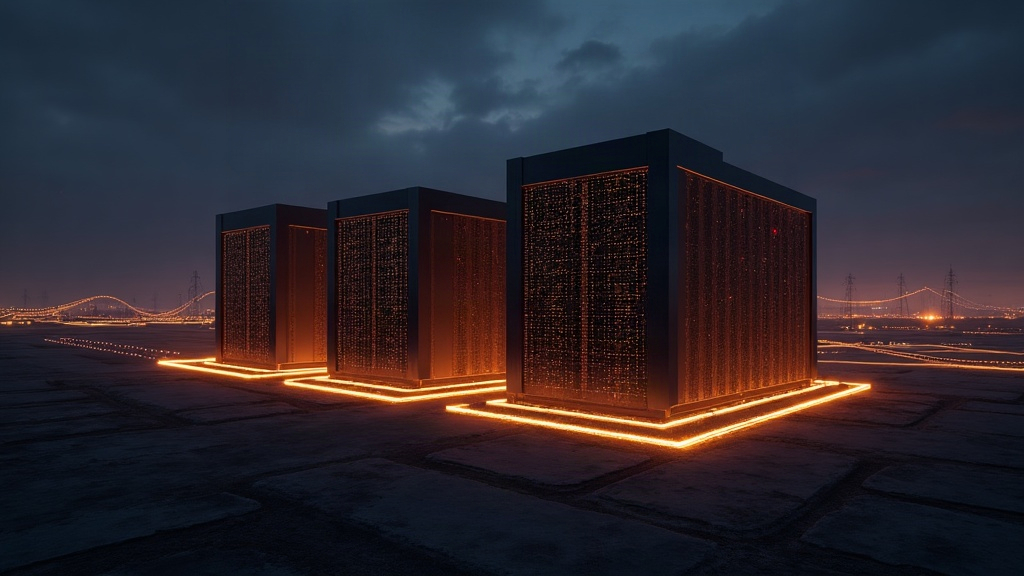
QTS Data Centers is planning a massive four-building data center campus in Midland, Texas, according to air-permit reporting first published by Aterio and picked up by The Cincinnati Enquirer. The project, named the Caprock Campus, is targeted for phased activation from late 2029 through September 2030 and would total approximately 1.2 gigawatts of capacity.
What was filed
Air-permit filings reveal a four-building campus with each building rated at approximately 300MW, powered entirely by on-site natural-gas generation. Filing date, final approval status, campus acreage, square footage, dollar investment, and tenant identity have not been established in available reporting.
| Detail | Reported figure |
|---|---|
| Buildings | 4 |
| Capacity per building | ~300MW |
| Total campus capacity | ~1.2GW |
| Power source | On-site natural-gas generation |
| Phased activation | Late 2029 through September 2030 |
Who QTS Data Centers is
QTS Data Centers is a hyperscale colocation and data center operator with facilities across North America and Europe. The company operates large-scale campuses for enterprise and hyperscale customers and has historically pursued sites where power infrastructure and land availability can support gigawatt-class buildouts. The Caprock Campus, if completed at the full 1.2GW scale, would rank among the largest single-campus data center projects in the United States.
Why Midland, and why now
- •The Permian Basin runs on power and pipelines. Midland sits at the heart of one of the most energy-dense industrial corridors in the country, with natural-gas infrastructure already in place. On-site gas generation becomes a logical choice when the fuel supply is effectively at your fence line.
- •Grid constraints are redirecting hyperscale development. Primary markets like Northern Virginia and Phoenix face power queue backlogs that push developers toward regions where they can generate their own power rather than wait years for utility interconnection.
- •Land and industrial permitting are easier here. West Texas has long accommodated large-footprint, high-impact industrial projects. The regulatory environment and available land make a four-building gigawatt campus more achievable than it would be in denser, more saturated markets.
- •Timing aligns with surging AI infrastructure demand. The 2029-2030 activation window matches the planning horizon of hyperscale customers racing to secure long-term capacity for AI training and inference workloads.
When a developer chooses on-site gas generation over grid interconnection, they are trading utility queue risk for fuel supply and air-permit risk, and Midland makes that trade more favorably than almost anywhere else in the continental United States.
Power strategy and infrastructure insight
The decision to power all four buildings with on-site natural-gas generation rather than a utility feed is the defining infrastructure choice of this project. It eliminates dependence on ERCOT queue timelines, which have stretched to years for projects at this scale, but it also means the campus will operate as its own generating facility subject to Texas Commission on Environmental Quality air-permit requirements. That is what the available reporting captures: permit filings, not a final approval. Until air permits are granted, the activation schedule remains contingent. For project planners and contractors, the practical implication is that mechanical, electrical, and controls scope on this campus will include a generation plant of meaningful scale layered on top of the standard data center fit-out, compressing two complex scopes into a single delivery timeline.
What it means for the region's labor market
Midland's heavy-construction and energy-sector workforce is one of the strongest in the country for the early phases of a project like this. Mining, logging, and construction accounted for 34.2% of local industry employment and added 1,900 jobs year over year in recent labor-market data, and the Permian Basin routinely produces experienced site developers, equipment operators, electricians, pipefitters, and mechanical workers who are accustomed to large industrial builds under tight schedules.
The challenge is not the ground-up construction phase. It is what comes after. Hyperscale commissioning, mission-critical electrical systems, building management and controls integration, and data center operations roles require specializations that are rarely developed in oilfield or gas-processing careers. Workers who have spent a decade on SCADA systems for pipeline compressor stations have transferable skills, but the bridge to hyperscale commissioning is not automatic. At 1.2GW across four buildings activated in phases, the Caprock Campus will need a sustained pipeline of that specialized talent stretching well beyond the initial build.
Regional competition for heavy-construction labor from Permian oilfield, pipeline, and gas-processing projects will add pressure throughout the construction window. QTS and its contractors will need a staffing strategy that accounts for both the depth of local industrial talent and the gap in data-center-specific experience. For a full breakdown of roles, pay ranges, and where the talent is, see our guide to hiring data center talent in Midland County. Sources: Aterio, which first reported the air-permit filings, and The Cincinnati Enquirer.
Have a data center role to fill?
Send us the role Monday. Get three screened candidates by Friday, ready to meet your hiring team.
Read More Blog Posts
Hiring Data Center Talent in Midland, TX: Roles, Pay, and Where the People Actually Are
QTS Data Centers is planning the Caprock Campus in Midland, Texas, four buildings rated at approximately 300 megawatts each, totaling roughly 1.2 gigawatts of capacity, powered by on-site natural-gas generation and targe
Hiring Data Center Talent in Corsicana, TX: Roles, Pay, and Where the People Actually Are
Riot Platforms is building something substantial in Navarro County. A 335,430-square-foot data center building under a $400 million construction schedule running from April 2026 through May 2028 is the near-term work.