
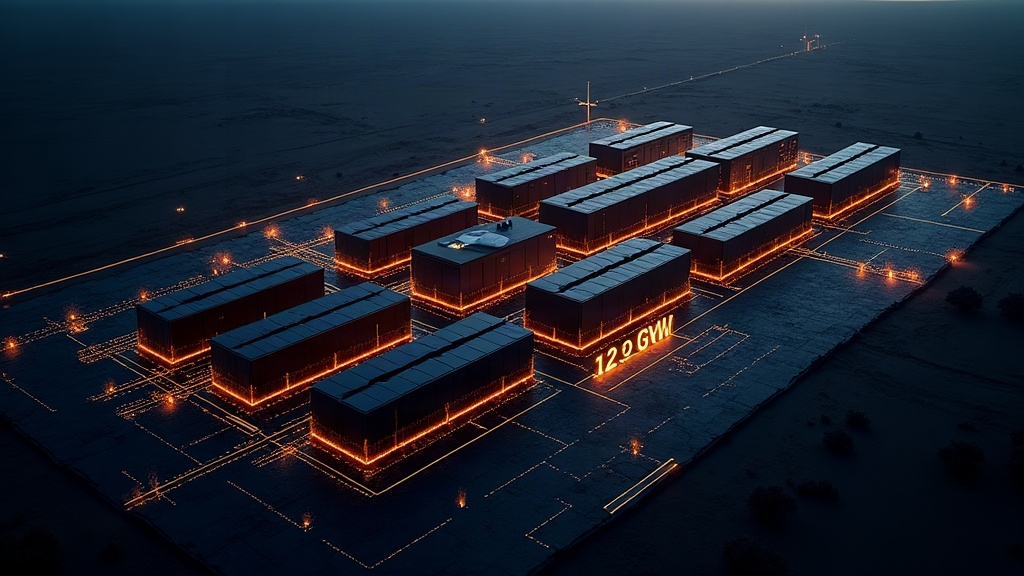
The Stargate program's flagship site is taking shape in Taylor County, Texas, where Oracle is developing and operating an eight-building, 1.2-gigawatt campus on roughly 1,000 to 1,100 acres at Lancium's Clean Campus outside Abilene to run OpenAI training and inference workloads. The project was first reported by Industrial Info Resources, with further coverage from Stargate.how, The Compute Wire, and ItechGuides.
What was filed and approved
Abilene City Council adopted an 85% property-tax abatement for Oracle. The campus broke ground in 2024, two buildings went live in September 2025, early workloads were reported running by July 2025, and Oracle stated that 42% of total capacity had been delivered as of August 5, 2026. The remaining capacity is scheduled for subsequent quarters, with full eight-building completion targeted around 2027.
| Detail | Figure |
|---|---|
| Total ERCOT-approved interconnection capacity | 1.2 GW |
| Data center buildings (core campus) | 8 |
| Total buildings including ancillary facilities | 10 |
| Site area | ~1,000-1,100 acres |
| Reported campus investment | ~$15 billion |
| Construction jobs | ~9,000 |
| Permanent jobs | ~1,000 |
| Projected city tax revenue (post-abatement) | ~$30 million per year |
| Status | Partially operational, still under construction |
A planned expansion from 1.2 GW to 2 GW, along with an associated roughly 600 MW add-on, was cancelled in March 2026. An adjacent parcel was reallocated to Microsoft. The core OpenAI-Oracle campus continues to build toward its 1.2 GW target.
Who is behind this campus
Oracle is developing and operating the site under the Stargate AI-infrastructure program, which OpenAI has described as a $400 to $500 billion multi-site initiative. The Abilene campus runs OpenAI training and inference workloads on NVIDIA GB200 systems via Oracle Cloud Infrastructure, making it less a conventional colocation or cloud node and more a purpose-built AI supercomputing facility at a scale the United States has not previously attempted in a single location.
Why Abilene, and why now
- •ERCOT capacity was available at scale. The campus secured 1.2 GW of ERCOT-approved interconnection, a figure that would be nearly impossible to assemble quickly in constrained markets like Northern Virginia or the Bay Area.
- •Lancium's Clean Campus de-risked the land and power deal. Siting on an existing high-availability, flexible-load campus compressed the procurement timeline for a project that needed to move fast.
- •West Texas avoids the coastal permitting drag. Texas's streamlined land-use and grid-interconnection processes allowed Oracle to break ground in 2024 and reach partial operation by mid-2025.
- •Closed-loop cooling fits a drought-prone region. The campus uses closed-loop cooling with both liquid- and air-cooling support, reducing dependence on water supply in an area where that constraint is real.
When a program needs gigawatt-scale AI infrastructure fast, it goes where land, transmission, and permitting converge rather than where data center ecosystems are already mature.
The infrastructure picture
The campus interconnects directly to the ERCOT grid, bypassing the regulated-utility queue structures that slow projects in other states. Lancium's flexible-load model means the campus can participate in ERCOT demand-response programs, which matters at 1.2 GW. The NVIDIA GB200 density also changes the mechanical and electrical loading profile relative to conventional hyperscale: these buildings are not interchangeable with a standard cloud shell, and commissioning requires specialists who understand AI-cluster networking, liquid cooling at rack level, and high-density power distribution, all of which are skills in short supply nationally.
What it means for the region's labor market
Abilene and Taylor County sit in an oil, gas, and power-oriented labor market with deep experience in heavy construction, transmission, and industrial maintenance. That background translates well to data center civil, mechanical, and electrical work, but the conversion is not automatic. Overwatch Mission Critical opened an Abilene operations hub in 2026 explicitly to serve this campus and Project Frontier, signaling that the regional ecosystem is being deliberately built rather than assumed. The nearest major supplemental labor pool is Dallas-Fort Worth, roughly 150 to 180 miles east, but DFW carries intense competing demand from its own hyperscale builds, limiting available surplus. The practical result is a staffing model that blends local energy-sector trades, inbound national mission-critical specialists, and periodic draws from DFW contractors, with training programs converting experienced energy-infrastructure workers into data-center-qualified roles. A campus still under active construction through 2027, with commissioning waves running in parallel, will sustain hiring pressure across multiple disciplines simultaneously. We break down roles, pay bands, and where the talent is in our guide to hiring data center talent in Taylor County, Texas.
Sources: Industrial Info Resources, which first reported the campus details, with additional coverage from Stargate.how, The Compute Wire, ItechGuides, KUT / The Cool Down, Cryptobriefing, and Overwatch Mission Critical.
Have a data center role to fill?
Send us the role Monday. Get three screened candidates by Friday, ready to meet your hiring team.
Read More Blog Posts
Hiring Data Center Talent in Abilene, TX: Roles, Pay, and Where the People Actually Are
Abilene has a hiring problem that is only going to get harder. Oracle is building the flagship Stargate campus outside the city on behalf of OpenAI, a 1.2-gigawatt, eight-building complex on roughly 1,000 acres at Lanciu
Hiring Data Center Talent Near the Platte–Goshen County Line, WY: Roles, Pay, and Where the People Actually Are
Rural eastern Wyoming is about to have a data center hiring problem it has never faced before.