
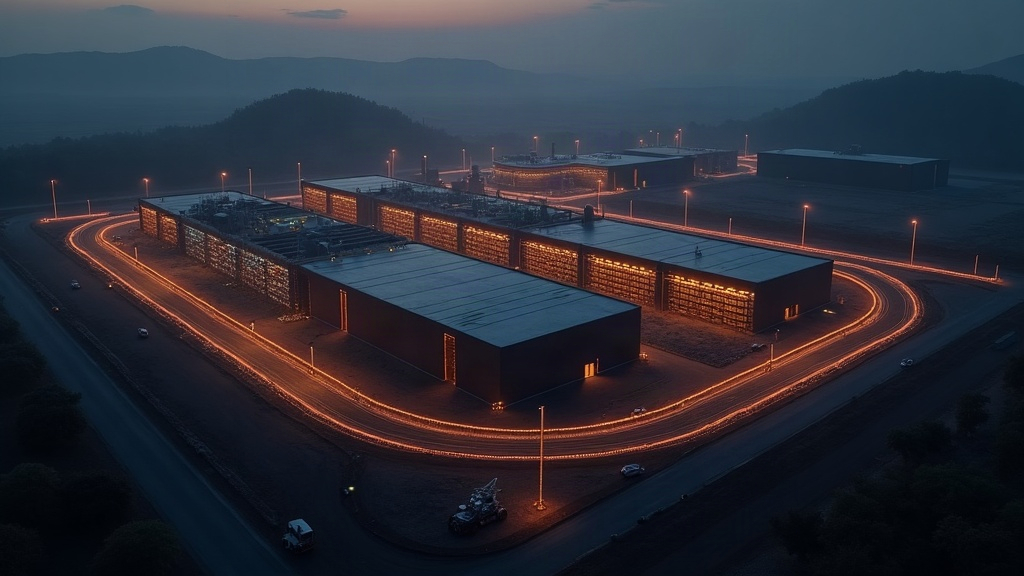
Switch, the Las Vegas-based hyperscale and wholesale data center operator, has filed plans with Big Beaver Borough to develop a three-building data center campus in Beaver County, Pennsylvania, about 40 minutes northwest of Pittsburgh. The site is the former Pittsburgh International Race Complex, the shuttered motorsports track locally known as Pitt Race. The project was first reported by the Pittsburgh Post-Gazette and picked up across the trade press, including Data Center Dynamics, and marks Switch's expansion into Pennsylvania.
What was filed
The campus, referred to in filings as Big Beaver Data Center / Switch Pit 01-03, comprises three buildings. Power is the headline: total backup generator capacity is listed at up to 270MW, fed by a new FirstEnergy switching station tied into 345kV transmission lines that already cross the property.
| Detail | Filed figure |
|---|---|
| Buildings | 3 |
| Size per building | 201,690 sq ft |
| Total generator capacity | up to 270MW |
| Power | new FirstEnergy switching station on existing 345kV lines |
| Phase one | as early as January 2028 |
| Full buildout | January 2030 |
Who Switch is
Switch operates some of the largest data center campuses in the United States, branded as its PRIME facilities, and serves wholesale and hyperscale tenants. This is not a small regional developer testing an idea. A filing of this scale signals a deliberate extension of the operator's footprint into a new region, and for Beaver County it means the counterparty has the balance sheet and operating track record to actually build and run 270MW. That raises both the opportunity and the stakes of the local decision.
Why Beaver County, and why now
Switch's move fits a pattern that is reshaping where data centers get built.
- •Primary markets are saturating. Northern Virginia, the world's largest data center hub, is hitting power and land constraints, and developers are chasing secondary markets with available transmission.
- •The power was already there. The 345kV lines on the former race track meant Switch could target energization years sooner than a site requiring new transmission.
- •The land had a second life. Reusing a defunct motorsports complex sidesteps some of the greenfield friction of building on undeveloped land.
The same logic is playing out in secondary markets nationwide, from central Ohio to Indiana to the Carolinas, wherever spare transmission and developable land intersect. What used to be a Northern Virginia and Dallas story is becoming a map of wherever the grid has headroom.
This is what the buildout wave looks like as it spreads beyond the traditional hubs. Where there is spare high-voltage transmission, a hyperscale campus can follow.
The grid is the real constraint
The detail that deserves more attention than it usually gets is the 345kV switching station. Transmission-level power, not land or construction, is the binding constraint on data center development in 2026. Interconnection queues in major markets stretch for years, and utilities are increasingly cautious about committing hundreds of megawatts to a single load. A site with 345kV lines already crossing it is rare and valuable precisely because it skips the longest and least certain part of the timeline. Switch's choice of a former race track is, at bottom, a choice about power.
Local reception
The project has drawn organized opposition. Residents have gathered against the development, and the borough and county have held public sessions on the plan. The concerns raised, around traffic, noise, water use for cooling, and the effect of a large industrial load on local power, mirror those in data center fights across the country, and they are increasingly deciding whether and how fast these projects move. For a build on this timeline, local permitting and zoning outcomes are the variable most likely to shift the schedule in either direction.
What it means for the region's labor market
A 270MW campus is a multi-year, multi-wave hiring event: construction trades first, then commissioning engineers, then permanent critical-facilities operations staff. Beaver County's building-trades depth positions it well for the construction phase. The specialized commissioning and operations talent a hyperscale campus requires is a different story, scarce in the region and largely sourced from outside it. We break down the specific roles, 2026 pay, and where that talent actually is in our guide to hiring data center talent in Beaver County. Sources: the Pittsburgh Post-Gazette, which first reported the filing, and Data Center Dynamics. Additional coverage: WPXI and Beaver County Radio.
Have a data center role to fill?
Send us the role Monday. Get three screened candidates by Friday, ready to meet your hiring team.
Read More Blog Posts
TeraWulf Wins Kentucky PSC Approval for 482MW Power Agreement at Former Hawesville Aluminum Smelter
TeraWulf (NASDAQ: WULF) secured approval from the Kentucky Public Service Commission on August 21, 2026, for a retail electric service agreement that will deliver up to 482MW to its "Justified" hyperscale campus on the f
Hiring Data Center Talent in Beaver County, PA: Roles, Pay, and Where the People Actually Are
Switch is building a 270MW data center in Beaver County. Here is the honest map of who you need to hire, what they pay in 2026, and where that talent actually is.