
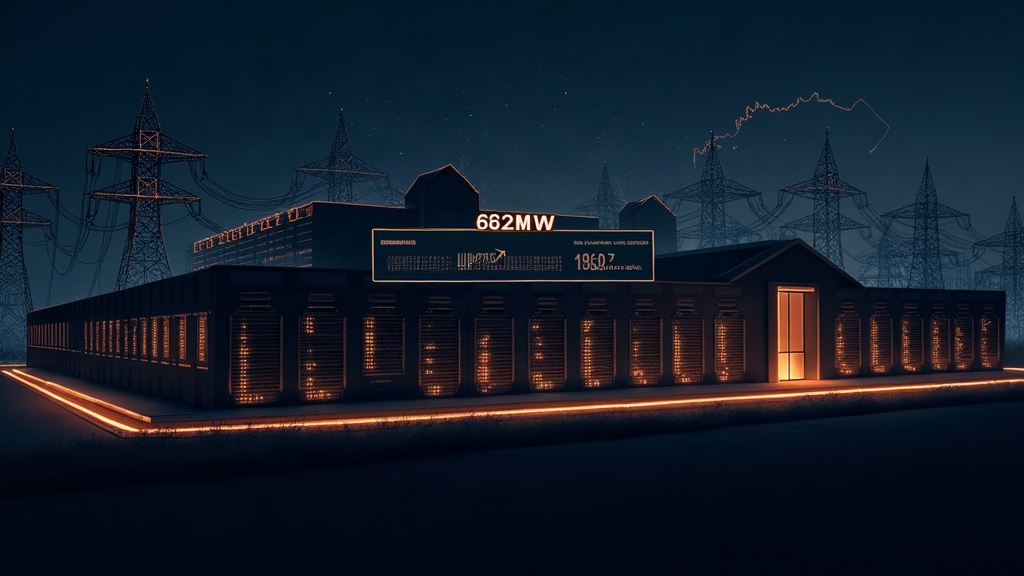
TeraWulf (NASDAQ: WULF) secured approval from the Kentucky Public Service Commission on August 21, 2026, for a retail electric service agreement that will deliver up to 482MW to its "Justified" hyperscale campus on the former Century Aluminum smelter site in Hawesville, Hancock County, Kentucky. The approval, first reported by the Kentucky Lantern, authorizes Big Rivers Electric Corp. and Kenergy Corp. to serve the project. The Owensboro Times and StockTitan have also covered the project.
What was approved
The PSC action clears the power delivery structure for the campus. No construction permit for buildings has been filed; this is the power-agreement milestone.
| Detail | Figure |
|---|---|
| Campus name | Justified |
| Site | Former Century Aluminum Hawesville smelter |
| Buildable acres | 250+ |
| Approved power capacity | 482MW |
| Utility approvals | Big Rivers Electric Corp. and Kenergy Corp. |
| Approval date | August 21, 2026 |
| Total investment (site + initial data halls) | $4B to $4.5B |
| AI tenant interest | Anthropic |
Who TeraWulf is
TeraWulf is a publicly traded developer (NASDAQ: WULF) that has pursued large-scale digital infrastructure on sites with existing high-voltage power infrastructure. The Justified campus represents the company's entry into hyperscale data center hosting at a scale that puts it alongside the largest campuses currently in development anywhere in the United States.
Why Hawesville, and why now
The logic of this site is almost entirely about what the aluminum smelter left behind.
- •482MW was already interconnected. Century Aluminum's operations required continuous, massive power delivery. When the smelter halted in 2022, the transmission infrastructure stayed. TeraWulf is not waiting on an interconnection queue; the capacity exists.
- •250+ buildable acres on a single brownfield parcel. Assembling that footprint in a greenfield market would take years and multiple landowners. The industrial consolidation was already done.
- •Anthropic's interest signals real demand. A tenant relationship at this scale, with one of the most compute-intensive AI developers operating today, is a commercial anchor that moves a project from speculative to credible.
- •Kentucky is systematically targeting idle industrial sites. Hawesville is part of a deliberate state pattern: former energy-intensive manufacturing sites, built around high-voltage feeds, are being repositioned for data center use before those transmission assets are stranded permanently.
When an aluminum smelter closes, it leaves behind exactly what a hyperscale campus needs most in 2026, the hard part, the transmission, and the PSC approval converts that stranded infrastructure into a contracted asset.
The power asset is the project
Interconnection queue timelines in active markets now routinely stretch three to five years. The 482MW at Hawesville bypasses that entirely because the smelter's load was already on the grid. The PSC approval formalizes what the physical infrastructure made possible: Big Rivers and Kenergy can now contract to serve a single customer at a scale that would be politically and logistically difficult to approve for a greenfield applicant with no prior industrial relationship to the site. That is the structural advantage brownfield industrial sites hold over any alternative in the current environment.
What it means for the region's labor market
Hawesville presents a labor picture that is genuinely unlike most rural data center sites, and the distinction matters for staffing strategy. The former Century Aluminum smelter employed a resident workforce of heavy-industrial trades: pot-line electricians, millwrights, riggers, and high-voltage electrical workers. That population has been largely idle since 2022 and sits within the local commute shed. For the construction wave a 482MW campus requires, that is a real and deployable asset that most rural sites cannot claim. The gap is on the operations side. Smelter-trained trades are not critical-facilities technicians or commissioning engineers. That skill set does not exist in Hancock County in any meaningful depth. Owensboro is roughly 40 minutes away; Louisville is two hours. The commissioning and permanent operations talent this campus will need must be sourced regionally and, for senior roles, nationally. The practical implication: construction hiring can lean on local trades sooner and more aggressively than a typical rural project. Operations hiring requires a different strategy from the start. We break down the specific roles, 2026 pay benchmarks, and where that talent actually is in our guide to hiring data center talent in Hancock County, Kentucky. Sources: the Kentucky Lantern, which first reported the PSC approval; the Owensboro Times; and StockTitan.
Have a data center role to fill?
Send us the role Monday. Get three screened candidates by Friday, ready to meet your hiring team.
Read More Blog Posts
Hiring Data Center Talent in Hawesville, KY: Roles, Pay, and Where the People Actually Are
Hancock County is about to have a data center hiring problem. On August 21, 2026, the Kentucky Public Service Commission approved the retail electric service agreement allowing Big Rivers Electric Corp.
Switch Files to Build a 270MW Data Center on a Former Beaver County Race Track
Switch has filed to develop a three-building, 270MW data center campus on the former Pittsburgh International Race Complex in Beaver County, PA, with phase one targeted for January 2028.