
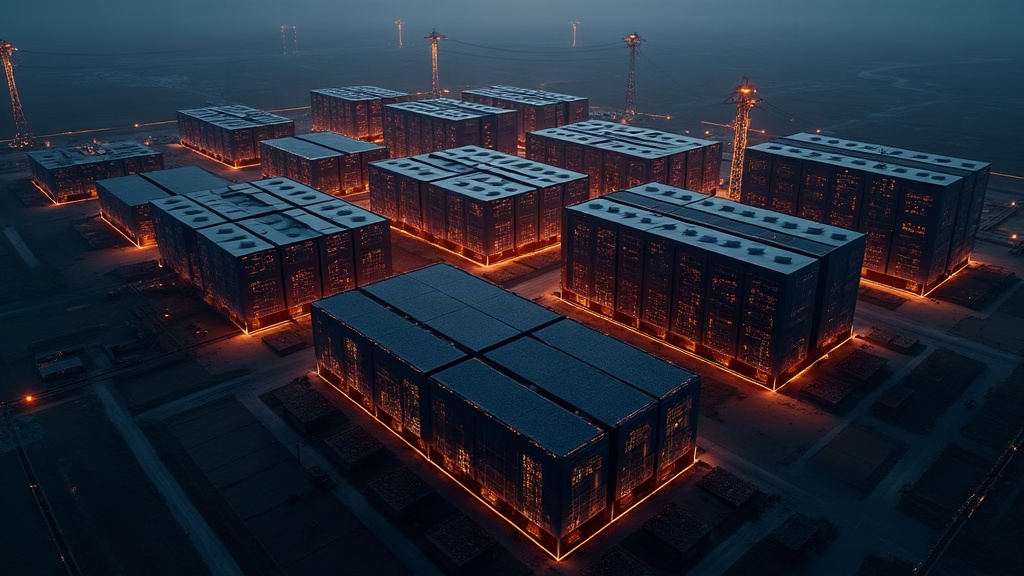
Fluidstack, a New York-based AI infrastructure developer, has begun site work on a large-scale AI data center campus in Harlingen, Cameron County, Texas, representing a $4 billion first-phase investment on more than 1,000 acres along FM 106 near Rio Hondo. The project was first reported by KRGV and has been covered by ValleyCentral and the RGV Business Journal.
What was filed and approved
Cameron County issued a worksite permit for the area east of FM 509 and west of FM 106, enabling site work to begin in early September 2026. The campus sits east of Valley International Airport and west of the Port of Harlingen, giving it direct proximity to two major regional infrastructure anchors.
| Detail | Filed figure |
|---|---|
| Site area | More than 1,000 to 1,100 acres |
| Phase 1 investment | Approximately $4 billion |
| Construction start | Fall 2026 (site work underway as of September 2026) |
| Phase 1 completion | Mid-2028 |
| Cooling approach | Closed-loop water cooling |
| Water supply | East Rio Hondo Water Supply Corporation |
| Construction-phase water use | ~50,000 gallons per day |
| Operational water use | ~7,000 gallons per day |
No public figures for total megawatts, square footage, or building count have been released; those details are omitted here accordingly.
Who Fluidstack is
Fluidstack is a New York-based AI infrastructure company focused on building large-scale compute capacity for AI workloads. The Cameron County campus is described as a modern networking and data center campus. No specific anchor tenant or customer for the facility has been publicly identified.
Why Harlingen, and why now
- •Land at scale is available. More than 1,000 contiguous acres adjacent to existing road and port infrastructure is difficult to assemble in major Texas metros, and the Rio Grande Valley corridor offers it.
- •South Texas is outside the overheated competition zones. Austin and Dallas–Fort Worth are absorbing hyperscale investment and facing power queue backlogs; Cameron County sidesteps both.
- •Cross-border logistics infrastructure is already in place. Proximity to the Port of Harlingen and Valley International Airport means heavy equipment, modular components, and supplies can move efficiently during a multi-year build.
- •Water supply is secured. Partnering with East Rio Hondo Water Supply Corporation for a closed-loop system addresses one of the critical constraints for AI-optimized facilities before permits are finalized.
When land, water supply, and logistics infrastructure align in a secondary market, a project at this scale can move faster than it would in a congested primary hub.
A stormwater question still on the table
Fluidstack has sought approval from the Harlingen City Commission to discharge construction and operational stormwater into a major canal that drains Valley International Airport. The commission tabled that proposed agreement following public comment, and it remains pending as of early September 2026. This is not a project stoppage, but it signals that flood management and drainage engineering will be unusually consequential at this site. The campus sits in a region where canal systems and flood risk are active infrastructure concerns rather than background considerations, making civil and environmental permitting a longer-running story to watch.
What it means for the region's labor market
A $4 billion, 1,000-plus-acre campus is a multi-wave hiring event that will run from late 2026 through at least mid-2028 for phase one alone. The Rio Grande Valley has a genuine base of electricians, HVAC technicians, and civil construction trades drawn from airport operations, port logistics, regional healthcare systems, and light manufacturing. That base can absorb a meaningful share of the construction workforce, and the Brownsville–Harlingen metro and the broader McAllen–Mission corridor extend the local draw radius without running into the tech-cluster competition that affects sites near Austin or Dallas.
The gaps will be predictable for anyone who has staffed a greenfield hyperscale build: data center commissioning engineers, controls specialists, and critical-environment operations technicians are thin in this market. The less obvious gap, specific to this location, is civil and environmental engineering experience with flood risk and canal drainage systems. Because the stormwater discharge agreement is still unresolved and the site borders airport drainage infrastructure, contractors and long-term facilities staff with that background will carry more weight here than on a comparable build in a drier, less flood-sensitive region.
For a detailed breakdown of roles, pay ranges, and where to find qualified candidates across both construction and operations phases, see our guide to hiring data center talent in Cameron County, Texas. Sources: KRGV, which first reported the groundbreaking, along with ValleyCentral, the RGV Business Journal, and the Fluidstack Cameron County project site.
Have a data center role to fill?
Send us the role Monday. Get three screened candidates by Friday, ready to meet your hiring team.
Read More Blog Posts
Hiring Data Center Talent in Harlingen, TX: Roles, Pay, and Where the People Actually Are
Fluidstack is building a $4 billion AI data center campus on more than 1,000 acres in Cameron County, Texas, along FM 106 near Rio Hondo, and site work is already underway.
Hiring Data Center Talent in Oliver County, ND: Roles, Pay, and Where the People Actually Are
Applied Digital has begun site clearing and land grading for Polaris Forge 3, a roughly 300 MW high-performance computing campus west of Center, North Dakota.